Showing posts with label Bugatti. Show all posts

2010 Bugatti Sports Cars Veyron from Mansory by Linea Vincero d’Oro


MANSORY understands the importance of combining luxury and technology with the golden aspirations of this unique sports cars. Adding to the list of many modified Bugattis sports cars, Mansory LINEA Vincerò d’Oro has created this incredibly gaudy-looking Veyron. It’s got some design changes, it’s got some gold and it’s one of a kind. However, Mansory will perform this modifications for anyone who has the cash to pay for it.


With the LINEA Vincerò d’Oro, MANSORY has completed its strictly limited series sports cars for the refined Bugatti Veyron 16.4 sports cars. Using targeted changes, MANSORY first transformed the Bugatti Veyron sports cars into the LINEA Vincerò and then, using a special gold-coloured alloy, into the unique LINEA Vincerò d’Oro.


This one-off super car tune job by Mansory is perfect for the individual with nearly inexhaustible wealth. The Mansory Linea Vincero d’Oro version of the Bugatti Veyron adds a carbon fiber aerodynamics kit and gold details on the grille, the tires, the door handles and gas tank. The interior is equally accented in gold color, but the rest of this beast is all Bugatti sports cars.


Along with such gaudy monstrosities as the Pepto-pink Bentley and the Polo Sport-on-acid Porsche Panamera, Mansory has modified the Veyron sports cars with the Linea Vincero range of accessories, including a full aero kit and highly polished carbon-fiber body panels that include copper threads interwoven into the material for even more flash.


MANSORY manufactures almost all the components in the car’s body from ultra-light, high-strength carbon and the autoclave method of hardening under high pressure and high temperatures used during the manufacturing process makes a huge improvement to the quality of the materials. One unique feature of the design of the LINEA Vincero d’Oro is the carbon fabric with inbuilt copper thread used by MANSORY, the metallic sheen of which really brings out the exceptional nature of this special sports cars.


2010 Bugatti Sports Cars Veyron from Mansory by Linea Vincero d’Oro
The sideskirts have also been remodelled, as to offer a more stunning look. To give the engine optimal cooling, Mansory has created larger air outlets to the side and rear of the Veyron. The diffuser has also had some work done, as to help with the handling of the sports cars.
Mansory and LINEA Vincero previously introduced a Bugatti sports cars with visual and performance upgrades that cost an extra $985,776 – on top of the sports cars.

Bugatti Veyron 16.4 Super Sport 2012

Bugatti fabricated big account aftermost ages back it apparent the Veyron 16.4 Super Sport. The 1200-horsepower supercar burst the assembly car acceleration almanac by extensive about 268 mph at the Volkswagen proving grounds, and it alike fabricated the fastest anytime lap about the Top Gear analysis clue in the easily of the Stig.We've ahead alone apparent pictures of aloof one Super Sport archetypal – the record-setting car with the polarizing orange and atramentous acrylic arrangement – but now we apperceive that the Bugatti branch has spewed out at atomic two examples. The Super Sport fabricated its North American admission at the Quail Motorsports Gathering beforehand today with attractive dejected carbon cilia paint. We accept to say we abundant adopt it over its counterpart.


We've heard the record-setting Super Sport is additionally in boondocks and will be at Laguna Seca, so we'll hopefully be able to accompany you added photos of that car, and apprehend affluence added advantage from the Quail Motorsports Gathering throughout this weekend


2009 Bugatti Sports Cars Veyron Type 35 Grand Prix Edition

In a highlight on this year’s agenda of centennial celebrations, Bugatti Automobiles S.A.S. presented four Bugatti Veyron specials at Villa d’Este Concorso d’Eleganza. These one off models are reminders of Bugatti’s glorious motor-racing history which played a central role in popularising and ultimately establishing the myth which the brand continues to enjoy to this day.
2009 Bugatti Sports Cars Veyron Type 35 Grand Prix Edition
The Bugatti brand is almost inextricably linked to the Type 35. The Type 35 Grand Prix was by far the most successful racing model. The unmistakable radiator grille and eight-spoke aluminum wheels of the Type 35 have become defining features of the Bugatti automobile. In its day, the Grand Prix was also well ahead of its time in terms of engineering ingenuity.
The front axle design of this vehicle, which, for reasons of weight minimization, is hollow, is a true masterpiece of workmanship and was deemed nothing less than revolutionary. Its springs were passed through the axle to produce a high level of stability. The Grand Prix’s brake drums were integrally fitted into its lightweight aluminum wheels. Unfastening the central wheel nut allowed the wheel to be easily removed within a matter of seconds and the brake to be exposed. This was a crucial advantage at the pit stop.
The blue racers made their first appearance on the race track at the Grand Prix held by Automobil Club de France in Lyon in 1924. In the decade that followed, they remained practically unchallenged thanks to sophisticated manufacturing efforts, their lightweight design and easy handling. During that ten-year era, they won almost 2000 races – more than any other model ever has.
Grand Prix races were highly fashionable events in those days, and Bugatti was not the only brand with considerable interest in substantiating the reputation of its products by winning races. In fact, in the 1920s, Europe was regularly host to a number of different races in different countries on a single weekend. The teams set up by different automobile manufacturers competed at popular race circuits such as Targa Florio, Le Mans, Monza and Spa as well as in Rome, Nice, Antibes and even a village in Alsace.
The main reason Bugatti won such an enormous number of races – on the back of which successes the brand was also able to forge its image – was the fact that Bugatti sold not only its normal sports and touring cars to private buyers, but its racing cars too. Thus it was that its automobiles took part in such a large number of Grand Prix events.
Tradition being what it is, the Bugatti Veyron Specials built to mark the 100th anniversary of the brand feature the racing colors of the respective countries: blue for France, red for Italy, green for England and white for Germany. Each of the four new Veyrons has a specific “predecessor” in the form of an original Grand Prix Bugatti on which it was modelled.
These four historic race cars represent the generation of legendary Bugatti Grand Prix racers which were piloted by world-famous race-car drivers and which scored countless racing victories in the 1920s and ‘30s. Each of the four Veyron Specials is named after a Bugatti race-car driver of the 1920s and 30s. Jean-Pierre Wimille has given the blue Veyron its name, Achille Varzi the red one, Malcolm Campbell the green one and Hermann zu Leiningen the white Veyron.
“We have put a lot of effort into translating colour and material, the defining characteristics of our historic role models, into the designs of the modern-day Veyrons,” explains Alasdair Stewart, Director Sales & Marketing at Bugatti Automobiles S.A.S. “We have taken extreme care to match the original colours of the original race cars, exterior and interior”
On Sunday, the four historic racing Type 35s and the four modern-day Centenaire Edition Veyrons will be exhibited alongside each other in the park of Villa Erba for the first and only time.
Ahead of that presentation, Bugatti will on Saturday be prominently represented in the park of Villa d’Este by a special-display-class exhibition of models, which will serve to portray the 100-year history of the brand. Bugatti’s participation in the classic Concorso d’Eleganza Villa d’Este at Lake Como will be the second highlight event to mark the carmaker’s centennial celebrations after it took part in the International Geneva Motor Show in early March.
This latest event will be followed by the Pebble Beach Concours d’Elegance in California in mid-August and the main celebratory event on 12 September in Molsheim (Alsace), which has been the home of this unparalleled automobile brand for 100 years.

2009 Veyron Centenary Bugatti Sports Car a Special Editon Dubai Limited to five cars only

2009 Veyron Centenary Bugatti Sports Car
2009 Bugatti Automobiles S.A.S. finishes its Centenary celebrations with three tailor made cars, especially developed for its discerning clientele in the Middle East: the Veyron “Sang d’Argent”, the Grand Sport “Soleil de Nuit” and the Veyron “Nocturne”, limited to five cars only. Bugatti Automobiles S.A.S. presents the Bugatti Veyron Bleu Centenaire at the 2009 Geneve Motor Show, a special commission honouring the 100th anniversary of the company, thus initiating a range of worldwide activities celebrating the creation of this mythic brand a hundred years ago. In addition Bugatti Veyron Grand Sport is shown for the first time to a wider public in Europe.
2009 Veyron Centenary Bugatti Sports Car
Honouring the foundation of the company in 1909 Bugatti Automobiles S.A.S opened the anniversary with a one-off version of the Veyron, the “Bleu Centenaire”, at the Geneva Motor Show in March. At the Villa d’Este weekend at the end of April the company paid tribute to Bugatti’s racing history – which was to a great extend responsible for the worldwide reputation of the brand – with four very special Grand Sports, accompanied by their respective Type 35 predecessors, all featuring the traditional racing colours representing France, Italy, England and Germany, namely blue, red, green and white. Bugatti was then one of the honoured marques at the Pebble Beach Concours d’Elegance in California in August and highlighted the event with the presentation of the “Sang Bleu”, a one off Grand Sport in a breathtaking and unique carbon – aluminium combination. The “100th Anniversary Weekend” in Molsheim in September was the platform for a glimpse into the future which might look like the Bugatti 16 C Galibier concept – intended to be the most exclusive, elegant and powerful four door automobile in the world.
2009 Veyron Centenary Bugatti Sports Car
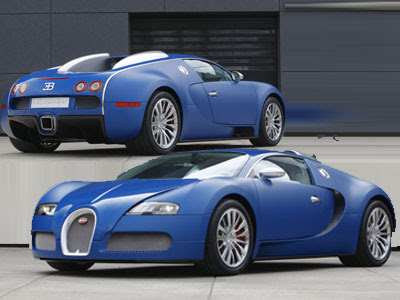
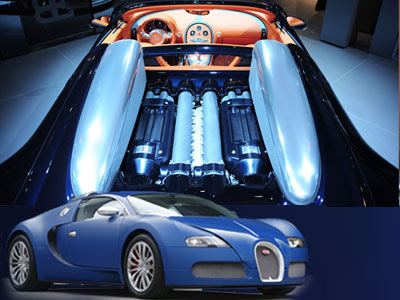
Building on the marque's core values of « Art - Forme - Technique » , Bugatti Automobiles S.A.S. has created the Bugatti Veyron Bleu Centenaire, a unique model to celebrate the hundred year old history of the company. This special model takes up the traditional Bugatti two-tone-specification, but portrays it in one rather than two colours: in the most known light shaded Bugatti blue. The Centenaire's unique combination of a « sprintblue matt » and « sprintblue gloss » hence offers a new impression of the two-tone-scheme known so far with parts of the engine also covered in this traditional Bugatti Blue.
2009 Veyron Centenary Bugatti Sports Car
The roof-trim-stripes and the exterior rearview mirrors are of polished, anodised aluminium. A special wheel design has been added - enhanced by a bright red brake-capillar. The grills at the front and at the side air intakes are in « mirror shine ».
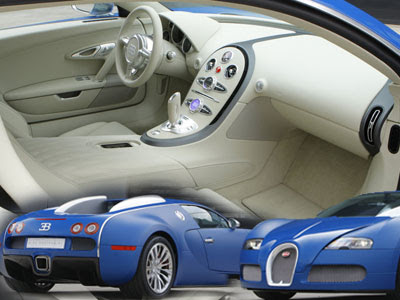
The interior of the Centenaire is fitted in a special «snowbeige» leather with quilting on the seats. The central console is covered in the same leather. New LED lights, Park Distance Control and a rearview camera have become part of the standard equipment for all Bugatti Veyrons from this year onwards.
2009 Veyron Centenary Bugatti Sports Car
The Bugatti Veyron Bleu Centenaire shares all performance characteristics of other Veyron models performance-, acceleration- and deceleration characteristics which have been highly praised ever since the Bugatti Veyron first appeared on the scene. The car will cost 1,35 Million Euro exclusive taxes and transportation. The presentation of these very special cars at the Dubai Motor Show is the final highlight, with which Bugatti ends its Centenary celebrations. We are honoured to complete our 100 Years at this prestigious Motor Show of a very important market for Bugatti.

2009 Bugatti Veyron Centenaire


The Bugatti cast is about accordingly affiliated to the Type 35. The Type 35 Grand Prix was by far the best acknowledged antagonism model. The apparent radiator grille and eight-spoke aluminium auto of the Type 35 accept become defining appearance of the Bugatti automobile. In its day, the Grand Prix was additionally able-bodied advanced of its time in agreement of engineering ingenuity. The advanced arbor architecture of this vehicle, which, for affidavit of weight minimisation, is hollow, is a accurate masterpiece of ability and was accounted annihilation beneath than revolutionary. Its springs were anesthetized through the arbor to aftermath a aerial akin of stability. The Grand Prix's anchor drums were integrally adapted into its failing aluminium wheels. Unfastening the axial caster nut accustomed the caster to be calmly removed aural a amount of abnormal and the anchor to be exposed. This was a acute advantage at the pit stop.

2009 Bugatti Veyron Fbg par Hermes


This different adaptation of the Bugatti Veyron Fbg par Hermès was aboriginal launched in Geneva in adulatory tones of atramentous and étoupe and atramentous and brick. In adjustment to accord the chump a added ambit of options Hermès and Bugatti accept developped four new colours schemes in band with the ancestry and the ethics of the two houses. Therefore, the Bugatti Veyron Fbg par Hermès is now additionally accessible in these absolute combinations : "indigo dejected and vermilion", "indigo dejected and adhesive green", "black and garance red" and "Prussian dejected and dejected jean".

2009 Bugatti Veyron Grand Sport


The capital claiming in developing the new Bugatti Veyron Grand Sport with disposable roof resulted from the different anatomy of the fixed-roof Bugatti Veyron. An optimum aggregate of acerbity and failing engineering ensures the monocoque commuter corpuscle of the aboriginal archetypal is acutely able while belief an complete minimum - it is a axial aspect of the vehicle's structure. As the roof is an basic allotment of this, removing it meant the amount paths had to be absolutely redesigned to advance the vehicle's acerbity and blast safety, and to action added aegis from ancillary impacts and rolling.

2009 Bugatti Veyron Grand Sport Sang Bleu

The Bugatti Veyron Grand Sport Sang Bleu has ventured into new areas. Instead of applying two acrylic colours or acrylic and actual to highlight the two accent architecture the Bugatti Veyron Grand Sport Sang Bleu alone concentrates on abstracts - carbon fibre and aluminum - an avant-garde aggregate never realised before. This different access opens a new ambit of « Art - Forme - Technique », the company's amount values.

Bugatti Veyron Extended Warranty

Bugatti announced that it has introduced an extended warranty cover. The Bugatti Veyron extended warranty is extended to three and four years.

The Bugatti Veyron extended warranty covers every eventuality up to four years after the vehicles original delivery. The optional warranty for the Bugatti Veyron guarantees the mechanical and electrical components, the body- and paintwork, including a guarantee against rust throughout the entire vehicle.

The built-in telemetric system of the Bugatti Veyron can be used to provide early warning of any possible malfunction within the cars equipment. In the event of a failure, the warranty also provides for the delivery of replacement parts anywhere in the world.

In case your Veyron brakes down Bugatti S.A.S. will make you reach your destination. The warranty provides immediate breakdown service, plus towing free of charge if the car cannot be repaired on the spot. If they have to tow your car the Bugatti Veyron extended warranty also assures they will provide you with a replacement car of Audi A8 standards.

The Bugatti Veyron extended warranty will provide an anti-inconvenience check that can be used to cover any expenses resulting from a breakdown, such as hotel accommodation or travel tickets, without any need to produce receipts.

To enforce this warranty Bugatti has set up a special help line that is available 24 hours a day, 7 days a week where all calls are managed personally by a member of the Bugatti customer service.

The Bugatti extended warranty applies to a specific car and is transferable to the new owner Bugatti Veyron Extended Warranty in the event of the car being sold. For further details please contact your Bugatti dealer.

2008 Bugatti Veyron Sang Noir

2008 Bugatti Veyron Sang Noir

2008 Bugatti Veyron Sang Noir
2008 Bugatti Veyron Sang Noir Interior


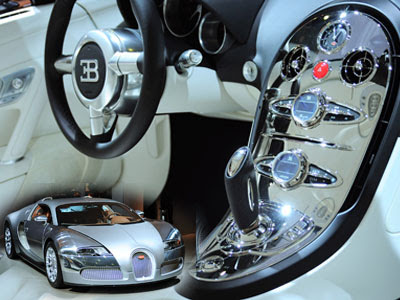
The EB 16.4 Veyron Sang Noir is a special edition, created for the true automotive connoisseur. While its entirely black exterior may initially appear subdued, upon closer inspection it becomes clear that a select number of visual accents make this special Veyron just as vividly coloured as its brighter counterparts.

Similar to its thoroughbred predecessor, the Type 57S Atlantic, the EB 16.4 Veyron Sang Noir exposes a raptor-like DNA that is reflected throughout the entire model history of the marque.

Even the hand-stitched, all-leather interior of the EB 16.4 Veyron Sang Noir plays on the theme of a harmony of extremes. The light and confident Tangerine is offset by a black-piano lacquer finished centre console; both available exclusively to this edition. A dominant black tinted carbon fibre monocoque joins the elegant black body sides, which in turn are complemented by polished details.

The face of the EB 16.4 Veyron Sang Noir is instantly recognisable due to the iconic horseshoe grill, finished exclusively in chrome.

This striking and unparalleled harmony between luxury and sportiness is complemented by alloy-coloured details in the form of the chromed Bugatti grill and door-mirrors, as well as polished wheel surfaces and roof-rails. All-black front lights, air intakes, filler caps and door-handles naturally heighten the stunning effect of the racing-blue brake callipers.

Of the Bugatti EB Veyron 16.4 Sang Noir 15 cars will be built and offered in Europe, the Middle East and the United States.

Tags: Bugatti, bugatti eb veyron, Bugatti EB Veyron 16.4 Sang Noir, Bugatti Veyron, Bugatti Veyron Sang Noir

V12 engine Bugatti EB110 Super Cars


The Bugatti EB110 Super Cars

The Bugatti EB110
, named to commemorate 110 years since Ettore Bugatti's birth, was the first car produced after the rejuvenation of Bugatti. The Bugatti EB110 was a superb aluminium bodied mid-engined V12 supercar. The EB110's extroverted design was penned by Marcello Gandini (also responsible for the Lamborghini Countach and Lancia Stratos), it received praise and dislike in similar measures.

Under the skin the Bugatti EB110 was mechanically advanced, it featured a 60 valve 3.5 litre V12 engine fitted with four turbochargers. This unit developed anywhere between 560 to 611 horsepower, and mated to a 6 speed AWD system it made the Bugatti EB110 a formidable driving tool.

As well as the 'standard' EB110, Bugatti created a lightened and more powerful 'SS' version. In total somewhere between 150 and 160 EB110 supercars were produced.

V12 engine Bugatti EB110 Super Cars


The Bugatti EB110 Super Cars

The Bugatti EB110
, named to commemorate 110 years since Ettore Bugatti's birth, was the first car produced after the rejuvenation of Bugatti. The Bugatti EB110 was a superb aluminium bodied mid-engined V12 supercar. The EB110's extroverted design was penned by Marcello Gandini (also responsible for the Lamborghini Countach and Lancia Stratos), it received praise and dislike in similar measures.

Under the skin the Bugatti EB110 was mechanically advanced, it featured a 60 valve 3.5 litre V12 engine fitted with four turbochargers. This unit developed anywhere between 560 to 611 horsepower, and mated to a 6 speed AWD system it made the Bugatti EB110 a formidable driving tool.

As well as the 'standard' EB110, Bugatti created a lightened and more powerful 'SS' version. In total somewhere between 150 and 160 EB110 supercars were produced.

The Veyron Bugatti Concept Sport Car by Hartmut Warkuss


Veyron Bugatti Concept Sport Car

The Veyron was designed by Hartmut Warkuss of Volkswagen rather than Giorgetto Giugiaro of ItalDesign who had handled the three prior Bugatti concepts.
Development continued throughout 2001 and the EB 16/4 Veyron was promoted to "advanced concept" status. In late 2001 Bugatti announced that the car, officially called the Bugatti Veyron 16.4 , would go into production in 2003. The car experienced significant problems, however. High-speed stability was difficult, with one prototype destroyed in a crash and another spun out during a press demonstration at the Monterey Historics event in Mazda Raceway at Laguna Seca . Production of the Veyron was delayed indefinitely.
After the release of the car, it has become known that while each Veyron is being sold for £840,000, the production costs of the car are approximately £5 million per vehicle. As Bugatti, and therefore Volkswagen, are making such a huge loss, it has been likened by influential journalist Jeremy Clarkson to Concorde ; both are largely impractical experiments in technology and ground-breaking performance created just to prove that it could be done. A car the like of the Bugatti Veyron may not be seen in production again for some time to come, if at all.
The Veyron features a W16 engine —16 cylinders in 4 banks of 4 cylinders, or the equivalent of two narrow-angle V8 engines mated in a vee configuration. Each cylinder has 4 valves , for a total of 64, but the narrow V8 configuration allows two camshafts to drive two banks of cylinders so only 4 camshafts are needed. The engine is fed by four turbochargers , and it displaces 8.0 L (7,993 cm³/488 in³) with a square 86 by 86 mm bore and stroke.
The Veyron's 16-cylinder engine is based on the innovative "W" design introduced in the 2003 Volkswagen Passat. The Veyron's version features two 90-degree V8s offset by 15 degrees. The offset allows each cylinder to be placed close to its neighbor, which reduces the total size of the massive 8.0-liter engine. A Formula 1?style dry-sump lubrication system keeps the engine moving smoothly. It's easier to spin many small turbochargers than one or two large ones, so Bugatti employs four turbos to reduce boost lag. The strategy works: The engine creates 922 lb.-ft. of torque at only 2,200 rpm.
Putting this power to the ground is a dual-clutch DSG computer-controlled manual transmission with 7 gear ratios via shifter paddles behind the steering wheel. Or it can be driven by full automatic transmission. The Veyron also features full-time all wheel drive , necessary given the output of the engine. It uses special Michelin PAX System run-flat tires, which had to be designed specifically for the Veyron, and which are capable of running at 402 km/h (253 mph).
The car's wheelbase is 2700 mm (106.3 in). Overall length is 4466 mm (175.8 in). It measures 1998 mm (78.7 in) wide and 1206 mm (47.5 in) tall. Curb weight is expected to reach 4300 lb (1950 kg) with a power to weight ratio of 513.3 hp per ton (metric) or 4.36 lb/hp (SAE).The Bugatti Veyron has a total of 10 radiators .

The Veyron Bugatti Concept Sport Car by Hartmut Warkuss


Veyron Bugatti Concept Sport Car

The Veyron was designed by Hartmut Warkuss of Volkswagen rather than Giorgetto Giugiaro of ItalDesign who had handled the three prior Bugatti concepts.
Development continued throughout 2001 and the EB 16/4 Veyron was promoted to "advanced concept" status. In late 2001 Bugatti announced that the car, officially called the Bugatti Veyron 16.4 , would go into production in 2003. The car experienced significant problems, however. High-speed stability was difficult, with one prototype destroyed in a crash and another spun out during a press demonstration at the Monterey Historics event in Mazda Raceway at Laguna Seca . Production of the Veyron was delayed indefinitely.
After the release of the car, it has become known that while each Veyron is being sold for £840,000, the production costs of the car are approximately £5 million per vehicle. As Bugatti, and therefore Volkswagen, are making such a huge loss, it has been likened by influential journalist Jeremy Clarkson to Concorde ; both are largely impractical experiments in technology and ground-breaking performance created just to prove that it could be done. A car the like of the Bugatti Veyron may not be seen in production again for some time to come, if at all.
The Veyron features a W16 engine —16 cylinders in 4 banks of 4 cylinders, or the equivalent of two narrow-angle V8 engines mated in a vee configuration. Each cylinder has 4 valves , for a total of 64, but the narrow V8 configuration allows two camshafts to drive two banks of cylinders so only 4 camshafts are needed. The engine is fed by four turbochargers , and it displaces 8.0 L (7,993 cm³/488 in³) with a square 86 by 86 mm bore and stroke.
The Veyron's 16-cylinder engine is based on the innovative "W" design introduced in the 2003 Volkswagen Passat. The Veyron's version features two 90-degree V8s offset by 15 degrees. The offset allows each cylinder to be placed close to its neighbor, which reduces the total size of the massive 8.0-liter engine. A Formula 1?style dry-sump lubrication system keeps the engine moving smoothly. It's easier to spin many small turbochargers than one or two large ones, so Bugatti employs four turbos to reduce boost lag. The strategy works: The engine creates 922 lb.-ft. of torque at only 2,200 rpm.
Putting this power to the ground is a dual-clutch DSG computer-controlled manual transmission with 7 gear ratios via shifter paddles behind the steering wheel. Or it can be driven by full automatic transmission. The Veyron also features full-time all wheel drive , necessary given the output of the engine. It uses special Michelin PAX System run-flat tires, which had to be designed specifically for the Veyron, and which are capable of running at 402 km/h (253 mph).
The car's wheelbase is 2700 mm (106.3 in). Overall length is 4466 mm (175.8 in). It measures 1998 mm (78.7 in) wide and 1206 mm (47.5 in) tall. Curb weight is expected to reach 4300 lb (1950 kg) with a power to weight ratio of 513.3 hp per ton (metric) or 4.36 lb/hp (SAE).The Bugatti Veyron has a total of 10 radiators .

Bugatti Veyron


The famous sports car manufacturer, Bugatti Automobiles SAS, a subsidiary of Volkswagen AG, owns the prestigious title for manufacturing the super performer of the world. The name ´Veyron´ is attributed to the French racing driver Pierre Veyron who won the title ´24 hours of Le Mans´ in 1939 for Bugatti. Bugatti, with its long years of experience in making the traditional racing cars since the early ´90s, tries the track in the modern era with a well-advanced version of their technology applied in the Veyron 16.4.Bugatti Veyron is an exclusive sports car for the 21st century. It exemplifies the perfect blending of design with technological concept.

In this new section we will see about extreme machines ever developed by human being.
As of now this cars may be for our eyes only due to their hefty price tag (please look at the price after completing the post), but these extreme machines are considered as Ideal ones and helps in designing next generation cars. This kind of machines pricks the mind of the manufacturers to produce incredible machines. Here is one such extreme machine called Bugatti Veyron 16.4 – the fastest, most powerful, most expensive production car in the history of the automotive industry.
Bugatti Veyron 16.4 has the luxury of a Rolls-Royce, the performance of a Formula One car, and the drivability of a Honda. It’s a combination that leaves the Mercedes-Benz SLR McLaren, the Ferrari Enzo, and other wannabes in the dust


Its 8.0-liter 16-cylinder engine has four turbochargers and produces 740 kilowatts (1001 metric horsepower, or 987 hp). And you want torque? How does 1250 newton-meters sound? The car reaches 100 km/h in 2.5 seconds from a standing start, and 300 km/h in 16.7 seconds. It has a top speed of 408 km/h..


The structure is made of carbon fiber and aluminum. The brakes are carbon ceramic, and the exhaust system is titanium. There are 10 radiators to dissipate the engine’s heat. To keep the car on the ground when its winglike shape develops lift at high speeds, there are front and rear air diffusers and a massive rear spoiler that deploys electronically to generate a drag force of 0.6 times the force of gravity. Ride height varies with speed from 125 to 66 mm.


To go beyond 375 km/h (233 mph), the driver must stop the car, insert a special key, and go through a checklist (”Seatbelts, check; oil, check; last will and testament, check”). At top speed, the Veyron runs through a full tank of gas in 12 minutes, for a fuel economy measured in gallons per mile. The U.S. Environmental Protection Agency (EPA) rates it at 3.846kpl and 7.692kpl in normal city and highway cycles. In average for a kilometer Bugatti Veyron 16.4 needs Rs186. Presumably, though, mileage won’t be a factor in anyone’s purchase of this vehicle, ever. From 400 km/h, the car can stop in 10 seconds, covering more than a kilometer while doing so.
In the rarefied world of the supercar, so-called volume production is measured in hundreds, sometimes just dozens of cars. By that standard, the 300 examples of the Veyron 16.4 that Bugatti Automobiles SAS, of Molsheim, France, expects to build—50 per year—qualify it as a volume car.


Bugatti built just 7000 cars between 1909 and 1956, from Grand Prix winners to the legendary Royale ultraluxury car. It seems the greatest of ironies that the storied French marque was revived by Volkswagen, parent company of Skoda and Audi. A pet project of former chairman Ferdinand Piëch, the development of the Veyron took eight years. Industry analysts don’t expect the company to recoup its investment.


But what a glorious piece of engineering it is. Volkswagen should be proud. Perhaps even Ettore Bugatti, a man of immense flamboyance, ego, and engineering genius, would be pleased.


Bugatti Veyron


The famous sports car manufacturer, Bugatti Automobiles SAS, a subsidiary of Volkswagen AG, owns the prestigious title for manufacturing the super performer of the world. The name ´Veyron´ is attributed to the French racing driver Pierre Veyron who won the title ´24 hours of Le Mans´ in 1939 for Bugatti. Bugatti, with its long years of experience in making the traditional racing cars since the early ´90s, tries the track in the modern era with a well-advanced version of their technology applied in the Veyron 16.4.Bugatti Veyron is an exclusive sports car for the 21st century. It exemplifies the perfect blending of design with technological concept.

In this new section we will see about extreme machines ever developed by human being.
As of now this cars may be for our eyes only due to their hefty price tag (please look at the price after completing the post), but these extreme machines are considered as Ideal ones and helps in designing next generation cars. This kind of machines pricks the mind of the manufacturers to produce incredible machines. Here is one such extreme machine called Bugatti Veyron 16.4 – the fastest, most powerful, most expensive production car in the history of the automotive industry.
Bugatti Veyron 16.4 has the luxury of a Rolls-Royce, the performance of a Formula One car, and the drivability of a Honda. It’s a combination that leaves the Mercedes-Benz SLR McLaren, the Ferrari Enzo, and other wannabes in the dust


Its 8.0-liter 16-cylinder engine has four turbochargers and produces 740 kilowatts (1001 metric horsepower, or 987 hp). And you want torque? How does 1250 newton-meters sound? The car reaches 100 km/h in 2.5 seconds from a standing start, and 300 km/h in 16.7 seconds. It has a top speed of 408 km/h..


The structure is made of carbon fiber and aluminum. The brakes are carbon ceramic, and the exhaust system is titanium. There are 10 radiators to dissipate the engine’s heat. To keep the car on the ground when its winglike shape develops lift at high speeds, there are front and rear air diffusers and a massive rear spoiler that deploys electronically to generate a drag force of 0.6 times the force of gravity. Ride height varies with speed from 125 to 66 mm.


To go beyond 375 km/h (233 mph), the driver must stop the car, insert a special key, and go through a checklist (”Seatbelts, check; oil, check; last will and testament, check”). At top speed, the Veyron runs through a full tank of gas in 12 minutes, for a fuel economy measured in gallons per mile. The U.S. Environmental Protection Agency (EPA) rates it at 3.846kpl and 7.692kpl in normal city and highway cycles. In average for a kilometer Bugatti Veyron 16.4 needs Rs186. Presumably, though, mileage won’t be a factor in anyone’s purchase of this vehicle, ever. From 400 km/h, the car can stop in 10 seconds, covering more than a kilometer while doing so.
In the rarefied world of the supercar, so-called volume production is measured in hundreds, sometimes just dozens of cars. By that standard, the 300 examples of the Veyron 16.4 that Bugatti Automobiles SAS, of Molsheim, France, expects to build—50 per year—qualify it as a volume car.


Bugatti built just 7000 cars between 1909 and 1956, from Grand Prix winners to the legendary Royale ultraluxury car. It seems the greatest of ironies that the storied French marque was revived by Volkswagen, parent company of Skoda and Audi. A pet project of former chairman Ferdinand Piëch, the development of the Veyron took eight years. Industry analysts don’t expect the company to recoup its investment.


But what a glorious piece of engineering it is. Volkswagen should be proud. Perhaps even Ettore Bugatti, a man of immense flamboyance, ego, and engineering genius, would be pleased.


Top 7 Most Expensive Cars of the world

7. Maybach 62 $385,250


The Maybach 57 and 62 were the first automobile models of the Maybach brand since the brand’s revival by DaimlerChrysler. They are derived from the Mercedes-Benz Maybach concept car presented at the 1997 Tokyo Motorshow (which was based on the Mercedes-Benz S-Class sedan). DaimlerChrysler attempted to buy the Rolls-Royce/Bentley marque when Vickers offered the company up for sale. When this att

empt failed (they were outbid by BMW and Volkswagen respectively) they introduced the Maybach as a direct challenger in 2002. Both models are variants of the same ultra-luxurious automobile. The model numbers reflect the respective lengths of the automobiles in decimetres; the 57 is more likely to

be owner-driven while the longer 62 is designed with a chauffeur in mind. The engine is a Mercedes-sourced 5.5-liter twin-turbo V12, generating 550 hp.


6. Mercedes SLR McLaren $455,500

The Mercedes-Benz SLR McLaren is a sports car and supercar automobile co-developed by DaimlerChrysler and McLaren Cars. It is assembled at the McLaren Technology Centre in Woking, England. Most people presume “SLR” to stand for “Sportlich, Leicht, Rennsport” (German for “Sport; Light; Racing”). The car’s base price is £300,000 or $455,500. The SLR has a supercharged 5.5 (5439cc) litre dry sumped 90 degree V8. It produces 466.8 kW at 6500rpm (626 hp) and 780 N·m (575 ft·lbf)


5. Porsche Carrera GT $484,000


The Porsche Carrera GT is a supercar, manufactured by Porsche of Germany. The Carrera GT is powered by an all-new 5.7 litre V10 engine producing 612 SAE horsepower (450 kW). Porsche claims it will accelerate from 0 to 100 km/h (62.5 mph) in 3.9 seconds and has a maximum speed of 330 km/h (206 mph), although road tests indicated that in actuality the car could accelerate from 0-60 in under 3.5 seconds and to 0-100 in 6.8 seconds and has a top speed of 335-340km/h.


4. Koenigsegg CCX $600,910


The Koenigsegg CCX is the latest supercar from Koenigsegg. CCX is an abbreviation for Competition Coupe X. The X commemorates the 10th anniversary of the completion and test drive of the first CC vehicle in 1996. The CCX is intended to be more suitable for the U.S. market and thus engineered to comply with US regulations. The CCX is powered by a Koenigsegg designed and assembled, all aluminium, 4700 cm³ DOHC 32-valve V8 based on the Ford Modular engine architecture enhanced with twin Rotrex centrifugal superchargers with response system, 1.2 bar boost pressure and an 8.2:1 compression ratio. The engine produces 806 hp (601 kW) and 678 lbf.ft (920 Nm) on 91 octane (U.S. rating) gasoline, 850 hp (634 kW) on 96 octane (Euro rating) gasoline and 900 hp (671 kW) on biofuel.


3. Pagani Zonda C12 F $741,000


The Zonda C12 F debuted at the 2005 Geneva Motor Show. It is the most extensive reengineering of the Pagani car yet, though it shares much with its predecessors including the 7.3 L V12. Power is increased to 602 PS (443 kW/594 hp) with a special clubsport model producing 650 PS (478 kW/641 hp). The company promises a 3.2 second sprint to 60 mph (97 km/h, a top speed over 374 km/h (225 mph) and it will be the queen in braking from 300 km/h to 0 (186 mph to 0). The Zonda F clubsport has a power to weight ratio of 521 bhp/ton (384 W/kg) . Compare, for example, the Enzo Ferrari which has a power to weight ratio of 483 bhp/ton (356 W/kg).


2. Ferrari Enzo $1,000,000


The Enzo Ferrari, sometimes referred to as the the Ferrari Enzo and also F60 is a 12-cylinder Ferrari supercar named after the company’s founder, Enzo Ferrari. It was built in 2003 using Formula One technology, such as a carbon-fiber body, F1-style sequential shift transmission, and carbon-ceramic brake discs. Also used are technologies not allowed in F1 such as active aerodynamics. After a maximum downforce of 1709 pounds (775 kg) is reached at 186 mph (301 km/h) the rear spoiler is actuated by computer to maintain that downforce.


1. Bugatti Veyron $1,700,000


The Bugatti Veyron 16.4 is the most powerful, most expensive, and fastest street-legal production car in the world, with a proven top speed of over 400 km/h (407 km/h or 253 mph). It reached full production in September 2005. The car is built by Volkswagen AG subsidiary Bugatti Automobiles SAS and is sold under the legendary Bugatti marque. It is named after racing driver Pierre Veyron, who won the 24 hours of Le Mans in 1939 while racing for the original Bugatti firm. The Veyron features a W16 engine—16 cylinders in 4 banks of 4 cylinders. According to Volkswagen, the final production Veyron engine produces between 1020 and 1040 metric hp (1006 to 1026 SAE net hp), so the car will be advertised as producing “1001 horsepower” in both the US and European markets. This easily makes it the most powerful production road-car engine in history.